

Tinea corporis, commonly known as ‘ringworm,’ is a superficial dermatophyte infection that affects the skin, excluding the hands, feet, scalp, bearded areas, face, groin, and nails. It is most often caused by dermatophytes from one of three genera: Trichophyton (infects skin, hair, and nails), Microsporum (infects skin and hair), and Epidermophyton (infects skin and nails).1
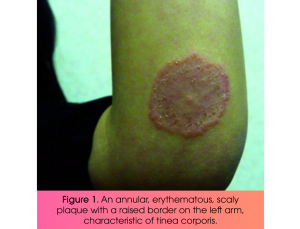
Clinically, tinea corporis appears as a well-demarcated, sharply circumscribed, oval or circular, mildly erythematous, scaly patch or plaque with a raised border. Mild itching is commonly associated.1
Figure 1. An annular, erythematous, scaly plaque with a raised border on the left arm, characteristic of tinea corporis.
Conditions presenting with annular lesions can resemble tinea corporis.
Differential diagnosis of tinea corporis
The differential diagnosis is broad and includes the following conditions.
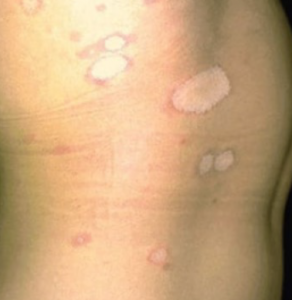
Distinguishing characteristics: A non-itchy herald patch is followed 4–14 days later by a generalized, bilateral, and symmetrical eruption, typically forming a characteristic ‘Christmas tree’ pattern on the back and a V-shaped distribution on the upper chest.1
Tinea versicolor
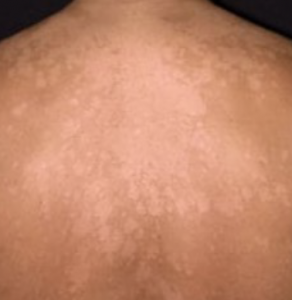
Distinguishing characteristics: Multiple well-demarcated, finely scaly brownish macules or patches are seen in fair-skinned individuals, while dark-skinned individuals exhibit hypopigmented macules or patches. Erythema is minimal or absent, and individual lesions lack a collarette of scales.1
Nummular eczema
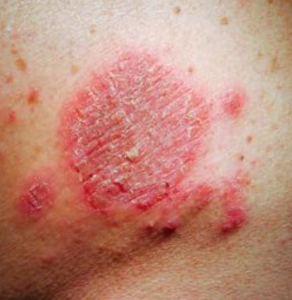
Distinguishing characteristics: Well-demarcated, pruritic, coin-shaped, symmetrical, eczematous, and scaly lesions, primarily affecting the extremities rather than the trunk, with acute lesions often showing serous exudate.1
Plaque psoriasis
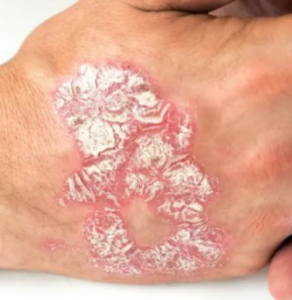
Distinguishing characteristics: Well-demarcated, sharply circumscribed, annular, erythematous, round or oval pruritic plaques with loosely adherent silvery-white, micaceous scales.1
Fixed drug eruptions
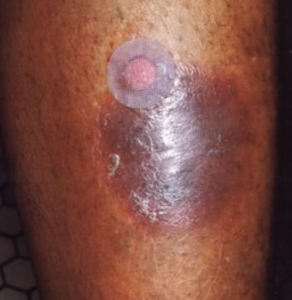
Distinguishing characteristics: Well-demarcated, round to oval erythematous or violaceous macules or plaques, typically without systemic symptoms, commonly affecting the hands, feet, lips, and perianal area.1
Erythema multiforme
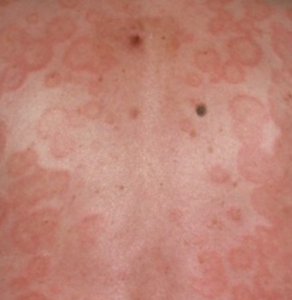
Distinguishing characteristics: Distinct targetoid lesions with central erythema, predominantly distributed on acral areas.1
Secondary syphilis
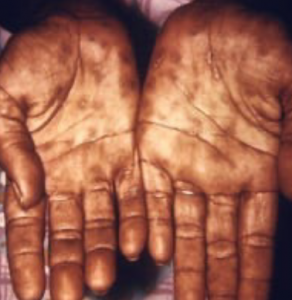
Distinguishing characteristics: Asymptomatic, diffuse, symmetrical, round to oval pink to reddish-brown monomorphous macules or patches appear on the trunk and extremities, including the palms and soles.
References:
- Leung AK, Lam JM, Leong KF, et al. Tinea corporis: An updated review. Drugs Context. 2020;9:2020-5–6.
- Pityriasis Rosea. Available at: https://www.msdmanuals.com/professional/dermatologic-disorders/psoriasis-and-scaling-diseases/pityriasis-rosea. Accessed on July 11, 2025.
- Tinea versicolor. Available at: https://www.msdmanuals.com/professional/dermatologic-disorders/fungal-skin-infections/tinea-versicolor#Symptoms-and-Signs_v964824. Accessed on July 11, 2025.
- Nummular dermatitis. Available at: https://www.msdmanuals.com/professional/dermatologic-disorders/dermatitis/nummular-dermatitis. Accessed on July 11, 2025.
- Plaque psoriasis. Signs and treatment. Available at: https://www.webmd.com/skin-problems-and-treatments/psoriasis/plaque-psoriasis-facts. Accessed on July 11, 2025.
- Drug eruptions and reactions. Available at: https://www.msdmanuals.com/professional/dermatologic-disorders/hypersensitivity-and-reactive-skin-disorders/drug-eruptions-and-reactions. Accessed on July 11, 2025.
- Erythema multiforme. Available at: https://www.msdmanuals.com/professional/dermatologic-disorders/hypersensitivity-and-reactive-skin-disorders/erythema-multiforme. Accessed on July 11, 2025.
- Available at: https://www.msdmanuals.com/professional/infectious-diseases/sexually-transmitted-infections-stis/syphilis#Symptoms-and-Signs_v1024210. Accessed on July 11, 2025.
Expert opinion – Dr. Belliappa P R
Correct diagnosis of tinea corporis is crucial, as inappropriate treatment can lead to the infection spreading to other parts of the body. Use of topical steroids can worsen the condition, alter its clinical features, and result in what is known as tinea incognito. When there is uncertainty in diagnosis, a KOH scraping is performed to confirm the condition. Microscopic examination of the scraping reveals septate, branched hyphae and spores. Once tinea corporis is confirmed, it should be treated with antifungal therapy—either topical or systemic—depending on the severity of the lesions.