

The term “acne-like eruptions” encompasses a range of skin conditions that resemble acne vulgaris. While both acne-like dermatoses and true acne are frequently observed in clinical settings, differentiating between them can be challenging. Various lesions sharing common features with acne can present in adulthood. Similar to acne, the lesions of acne-like eruptions may exhibit papules, pustules, nodules, and cysts. However, contrary to acne, comedones are uncommon but may still be observed in certain types of acne-like eruptions. Moreover, acne-like eruptions can be differentiated from acne based on their sudden onset, the propensity to occur across all age groups, the monomorphic appearance of lesions, and the distributions extending outside the seborrheic regions. The development of acne-like eruptions cannot be attributed to a single underlying mechanism; however, various factors, such as patient age, infections, occupation, habits, cosmetics, and medications, may be involved.
Most dermatoses should be included in the differential diagnosis when evaluating patients with lesions resembling acne. Recognition of the characteristic and distinguishing clinical features of these eruptions can facilitate the correct diagnosis.
Differential diagnosis of acne-like eruptions
Demodicosis
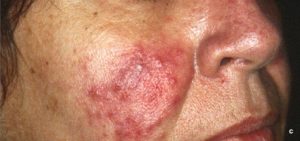
Distinguishing characteristics: Immunocompromised host, acaricidal therapies effective, sandpaper-like appearance, scaling, itching. Demodex infestation of eyelash hair follicles results in blepharitis, madarosis and ocular irritation.
Sarcoidosis
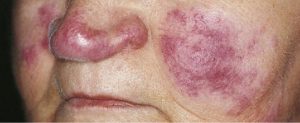
Distinguishing characteristics: Multisystem involvement, presence of systemic symptoms, onset usually after puberty. Presence of monomorphic papules; may coalesce into annular lesions or plaques, absence of comedones and pustules, papules may be accompanied by other specific and non-specific lesions of cutaneous sarcoidosis.
Pseudofolliculitis Barbae
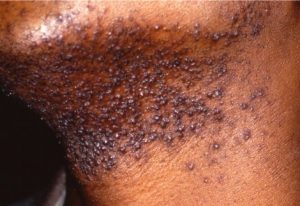
Distinguishing characteristics: The eruptions are quite similar to those of acne vulgaris; however, the absence of comedones is a crucial distinguishing feature.
Papular Granuloma Annulare
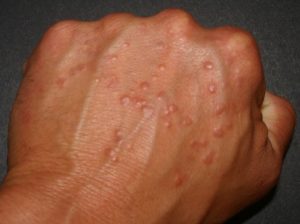
Distinguishing characteristics: The less typical papular presentation of granuloma annulare lacks the characteristic ring and hence may be misinterpreted as an acne eruption. However, acne can be excluded due to the dissimilar affected areas, the absence of epidermal changes, the absence of comedones and pustules, and a uniform morphology of GA lesions when compared to acne.
When evaluating acne-like eruptions, it is essential to obtain a comprehensive medical history, inquire about concomitant diseases, the use of specific products and prescription medications, exposure to physical and chemical agents, and conduct a thorough clinical examination. The implementation of existing knowledge about acne-like eruptions, along with further investigations into the pathophysiology of conditions that fall under this category, is fundamental for achieving an accurate diagnosis and favorable treatment outcomes.
Reference: Para´c E, Špiljak B, Lugovi´c-Mihi´c L, et al. Acne-like eruptions: Disease features and differential diagnosis. Cosmetics 2023;10:89.
Expert opinion – Dr. Mohammed Abdul Samad
This article delivers a concise and practical overview of acne-like eruptions, highlighting the importance of distinguishing them from true acne through subtle clinical clues. Its emphasis on onset, lesion uniformity, and distribution equips clinicians to avoid common diagnostic pitfalls. By outlining real-world triggers such as infections, occupational factors, and medication use, the article adds meaningful clinical relevance. The inclusion of key mimickers—such as demodicosis, sarcoidosis, pseudofolliculitis barbae, and papular granuloma annulare—enhances its depth and utility. Overall, it serves as a well-organized and valuable resource for improving diagnostic accuracy in routine dermatology practice.