

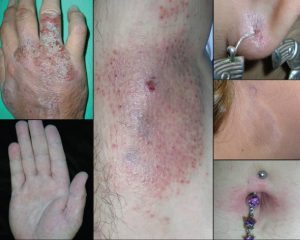
Contact dermatitis is a common inflammatory skin condition characterized by erythematous and pruritic skin lesions that occur after contact with a foreign substance. There are two forms of contact dermatitis: irritant and allergic. Irritant contact dermatitis is caused by the non-immune-modulated irritation of the skin by a substance, leading to skin changes. Allergic contact dermatitis is a delayed hypersensitivity reaction in which a foreign substance comes into contact with the skin, resulting in skin changes upon re-exposure to the substance. Contact dermatitis typically presents with erythema and scaling, often with distinct borders. Itching and discomfort may also occur. Acute cases may involve a dramatic flare with erythema, vesicles, and bullae; chronic cases may involve lichenification with cracks and fissures (Figure 1).
Differential diagnosis of contact dermatitis
Atopic dermatitis
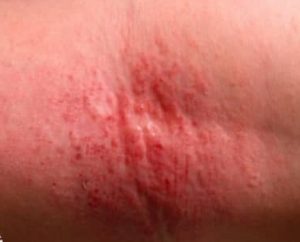
Distinguishing characteristics: More widespread than contact dermatitis and follows a certain distribution involving flexor surfaces
Dyshidrotic eczema
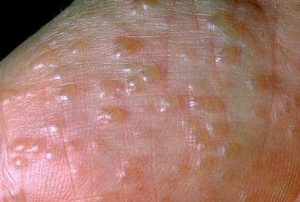
Distinguishing characteristics: Occurs on the hands and feet with clear, deep-seated vesicles resembling tapioca; erythema; and scaling
Inverse psoriasis
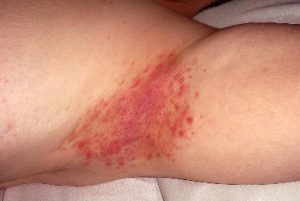
Distinguishing characteristics: Well-demarcated erythema in intertriginous areas
Palmoplantar psoriasis
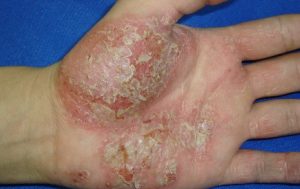
Distinguishing characteristics: Plaques and pustules on the palms
Contact dermatitis usually manifests as erythema and scaling with relatively well-demarcated, visible borders. The hands, face, and neck are usually involved, although any area can be affected.
Reference:
- Usatine RP, Riojas M. Diagnosis and management of contact dermatitis. Am Fam Physician. 2010;82(3):249–255.
Expert opinion – Dr. Girish H
Contact allergy is an acquired immunological alteration that occurs when the skin—and occasionally the mucosa or systemic circulation—comes into contact with low–molecular-weight substances. When the skin is involved, this reaction presents clinically as contact dermatitis, which includes both irritant contact dermatitis and allergic contact dermatitis. The clinical approach should involve taking a detailed history (including occupational and leisure exposures), performing a thorough skin examination, conducting patch testing with allergens based on the patient’s history and findings, and providing education about materials containing the identified allergen. Appropriate therapy and preventive strategies should also be implemented.