

Onychomycosis is a fungal infection of the toenails or fingernails that can involve any component of the nail unit, including the matrix, bed, and plate. It is a common disorder that can serve as a reservoir for infection, leading to significant medical problems. Moreover, onychomycosis can significantly impact one’s quality of life. An understanding of the disorder and updated management strategies is important for all healthcare professionals. Aside from reducing quality of life, sequelae of the disease may include pain and disfigurement, possibly leading to more serious physical and occupational limitations.1
Unfortunately, as medicine continues during the era of patients making diagnoses from the internet and photos driven by the media’s direct-to-consumer advertising, the perception of onychomycosis as a disease that requires objective proof of diagnosis and aggressive therapies continues to be an obstacle to successful treatment. 1
Onychomycosis is typically characterized by a yellow or brown, brittle nail plate with subungual hyperkeratosis causing onycholysis. Superficial onychomycosis presents with nail plate discoloration, superficial patches and transverse striae, and endonyx onychomycosis presents with lamellar splitting, discoloration and indentations. Proximal subungual onychomycosis predominantly presents with a whitish area in the proximal nail plate. (Figure 1)2
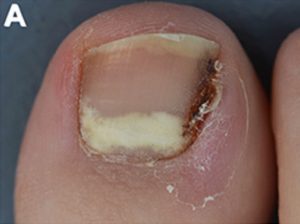
Differential diagnosis of onychomycosis
Trachyonychia
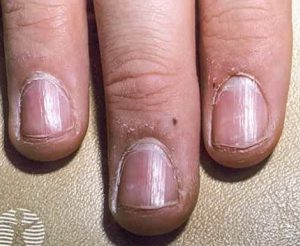
Distinguishing characteristics: Rough and brittle nail plate (opaque trachyonychia) or, less frequently, an opalescent nail plate lined with small geometric pits (shiny trachyonychia)2
Onycholysis
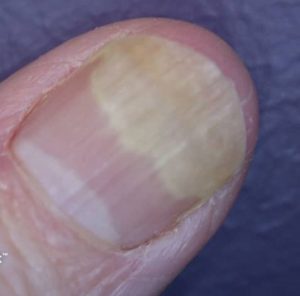
Distinguishing characteristics: The proximal border of onycholysis is linear with trauma but jagged with spiked edges in onychomycosis.2
Onychomadesis
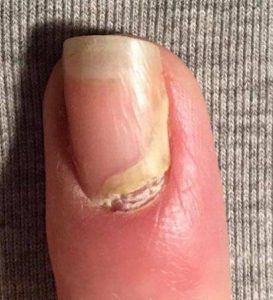
Distinguishing characteristics: Complete separation and shedding of the nail plate from the proximal nail bed due to temporary nail matrix arrest.2
Onychocryptosis
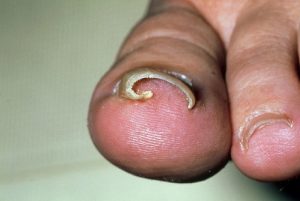
Distinguishing characteristics: Nail plate embedding within the periungual skin, causing painful inflammation, infection and granulation.2
The presence of any nail discoloration or change in integrity leads to a presumptive diagnosis of onychomycosis to the untrained eye.1 Therefore, the right diagnosis is essential in the management of onychomycosis.
Reference:
- Queller JN, Bhatia N. The dermatologist’s approach to onychomycosis. J Fungi (Basel). 2015;1(2):173–184.
- Lim SS, Ohn J, Mun JH. Diagnosis of onychomycosis: From conventional techniques and dermoscopy to artificial intelligence. Front Med (Lausanne). 2021;8:637216.
Expert opinion – Dr. Satish K M
Onychomycosis is sometimes a very challenging condition to diagnose, as several other disorders—such as nail psoriasis, trauma, and drug-induced onycholysis—can closely mimic its appearance. Fungal culture and KOH examination may also be inconclusive in some cases. A proper history along with thorough clinical examination is essential for making an accurate diagnosis.