

Acne vulgaris is a common cutaneous inflammatory disorder of the pilosebaceous unit, which runs a chronic course. The condition commonly manifests with papules, pustules, or nodules primarily on the face, although it can also affect the upper arms, trunk, and back. Acne vulgaris is commonly observed in adolescents and young adults. Its prevalence rates are estimated to range from 35% to over 90% among adolescents. The natural course of this disease can commence as early as ages 7–12 (preadolescent acne) and resolve by the third decade of an individual’s life. However, there are instances where acne can persist into adulthood or even develop for the first time during adulthood. The pathogenesis of acne vulgaris involves the interaction of multiple factors that ultimately lead to the formation of its primary lesion, which is known as “comedo” (Figure 1). Although acne vulgaris is commonly observed among adolescents, it is not restricted to this age group and can affect individuals of various ages. The severity of this condition can vary, ranging from a mild presentation with only a few comedones to more severe forms characterized by disfiguring inflammatory manifestations, which can lead to hyperpigmentation, scarring, and adverse psychological effects.1
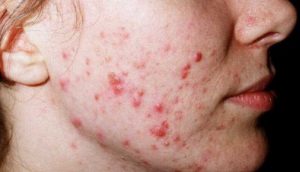
Differential diagnosis of Acne Vulgaris
Miliaria
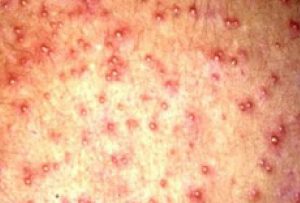
Distinguishing characteristics: Non-follicular papules, pustules, and vesicles; occurs in response to heat or exertion2
Pseudofolliculitis barbae
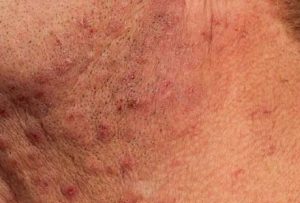
Distinguishing characteristics: Occurs in bearded areas with short, curly hair that is shaved closely2
Seborrheic dermatitis
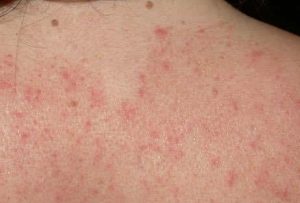
Distinguishing characteristics: Greasy scales with yellow-red, coalescing macules and papules2
Correctly identifying acne vulgaris is essential because several skin conditions—such as miliaria, pseudofolliculitis barbae, and seborrheic dermatitis—can mimic its papular or pustular appearance. Recognizing the defining features of true comedones and the typical distribution pattern helps differentiate acne from these look-alike dermatoses, ensuring accurate diagnosis and appropriate management.
Reference:
- Sutaria AH, Masood S, Saleh HM, et al. Acne Vulgaris. [Updated 2023 Aug 17]. In: StatPearls [Internet]. Treasure Island (FL): StatPearls Publishing; 2025 Jan-. Available from: https://www.ncbi.nlm.nih.gov/books/NBK459173/.
- Oge’ LK, Broussard A, Marshall MD. Acne vulgaris: Diagnosis and treatment. Am Fam Physician. 2019;100(8):475–484.
Expert opinion – Dr. Archhana Gullur
Acne vulgaris is a chronic inflammatory disorder of the pilosebaceous unit, characterized by comedones, papules, pustules, nodules, and cysts, most commonly affecting the face, back, and chest. In clinical practice, management is tailored to disease severity and individual patient factors. First-line therapies generally include topical benzoyl peroxide, retinoids, and antibiotics, which are often combined for synergistic benefit. For moderate to severe acne, oral antibiotics such as doxycycline or minocycline may be used, while oral isotretinoin is reserved for severe, scarring, or treatment-resistant cases. Adjunctive options including hormonal agents such as combined oral contraceptives or spironolactone in women, and intralesional corticosteroids for large inflammatory lesions, may be used when appropriate. Patient education on potential triggers, adherence, and medication side effects is essential for achieving optimal outcomes. When evaluating acne vulgaris, several conditions should be considered in the differential diagnosis, including acneiform eruptions such as drug-induced acne, rosacea, folliculitis, and perioral dermatitis. Drug-induced acne typically presents with abrupt onset and may be pruritic, lacking the polymorphic lesion pattern characteristic of acne vulgaris. Rosacea usually involves the central face with erythema, telangiectasia, and papules, but rarely comedones, and is often associated with flushing. Folliculitis may mimic acne but tends to affect hair-bearing areas; lesions can be pruritic or painful and may worsen with antibiotic use. Perioral dermatitis manifests as small papules and pustules around the mouth and nose, sparing the vermilion border, and typically does not involve comedones. Accurate diagnosis requires a careful clinical examination and detailed history, as overlapping features may occur and misdiagnosis can result in inappropriate therapy