

Urticaria is a common dermatologic condition that usually presents with intensely itchy, well-defined, raised wheals measuring from a few millimeters to several centimeters or more. Urticaria can occur with angioedema, which is localized nonpitting swelling of the subcutaneous or interstitial tissue that may be painful and warm. The severe itching can significantly impair daily activities and disturb sleep. Usually benign and self-limited, urticaria can be a sign of life-threatening anaphylaxis or, rarely, indicate serious underlying disease. It can appear on any part of the skin. The wheals may be pale or bright red, often with surrounding redness. The lesions are round, varied in shape, or serpiginous, and can rapidly expand and merge (Figure 1). Angioedema mainly affects the face, lips, mouth, upper airway, genitals, and extremities. Symptoms of urticaria or angioedema usually develop quickly, often within minutes. Individual urticarial lesions generally resolve within one to 24 hours without treatment, although new wheals may appear in waves. Angioedema can take days to resolve.
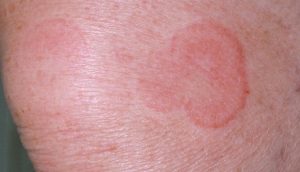
Differential diagnosis of Urticaria
Bullous pemphigoid
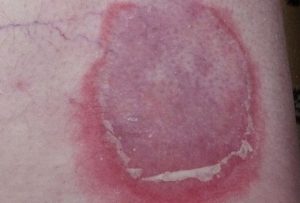
Distinguishing characteristics: Lesions lasting more than 24 hours, blistering, Nikolsky sign (light friction causes erosion or vesicle)
Erythema multiforme
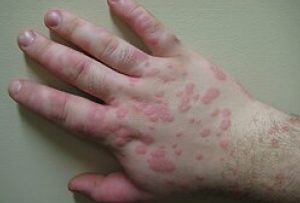
Distinguishing characteristics: Lesions lasting several days, iris-shaped papules, target appearance, may have fever
Henoch-Schönlein purpura
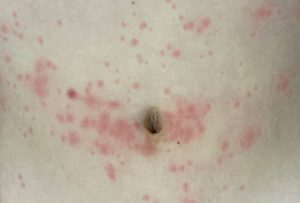
Distinguishing characteristics: Lower extremity distribution, purpuric lesions, systemic symptoms
Mastocytoma
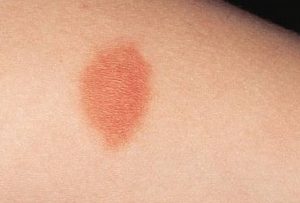
Distinguishing characteristics: Yellow to orange pigmentation, Darier sign (a wheal and flare-up reaction produced by stroking the lesion), flushing, bullae, occurs most commonly in children
Several dermatologic conditions can be confused with urticaria. Elements of the history and physical examination can help distinguish among these conditions.
Reference:
- Schaefer P. Acute and chronic urticaria: Evaluation and treatment. Am Fam Physician. 2017;95(11):717–724.
Expert opinion – Dr. Abhiram Rayapati
Urticaria remains one of the most frequently encountered dermatologic conditions in clinical practice; however, it continues to challenge both patients and primary care physicians due to its sudden onset, variable morphology, and overlap with several mimicking disorders. Accurate recognition is essential, not only for effective symptom control but also for the timely identification of potentially serious systemic associations. Typically, urticaria presents with intensely pruritic, well-defined wheals that appear abruptly, enlarge within minutes, and usually resolve within 24 hours. These transient lesions, which may be accompanied by angioedema, represent the hallmark of mast cell-mediated hypersensitivity. The short duration of individual wheals remains the single most practical diagnostic clue. Although most episodes are self-limiting, clinicians must remain vigilant. Urticaria can be an early manifestation of anaphylaxis and, in selected cases, may indicate an underlying autoimmune, infectious, or systemic disorder. A thorough clinical history, focusing on the time course, potential triggers, medication exposure, and associated systemic symptoms, remains invaluable.