

Palmoplantar pustulosis (PPP) is a chronic inflammatory and often painful disease characterized by sterile pustules on the palms and soles, significantly impairing quality of life. Women are more frequently affected than men, and smoking is a major trigger. Under biologic therapies, especially TNF antagonists, a paradoxical PPP may occur. PPP is associated with psoriasis vulgaris and may be accompanied by osteoarticular involvement. Pathogenetically, PPP likely begins around the acrosyringium, with the pustules consisting almost exclusively of infiltrating neutrophilic granulocytes attracted by chemotactic factors secreted by activated keratinocytes. Inflammation is sustained through a self-amplifying cytokine network, including interleukin (IL)-17, IL-19, and related mediators. PPP is a chronic or recurrent disease manifesting clinically with pustules, often on an erythematous, sometimes scaly base on palms and/or soles (Figure 1).
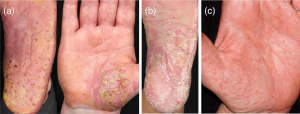
Differential diagnosis of palmoplantar pustulosis
Chronic hand eczema
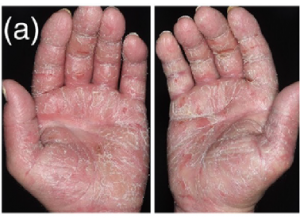
Distinguishing characteristics: Chronic hand eczema with hyperkeratosis, parakeratosis, acanthosis, and a perivascular lymphocytic infiltrate, but without intraepidermal pustules.
Dyshidrosiform eczema
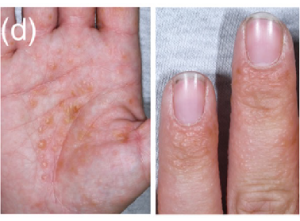
Distinguishing characteristics: Dyshidrosiform eczema with pronounced epidermal spongiosis and vesicle formation, but without neutrophilic infiltrates.
Tinea
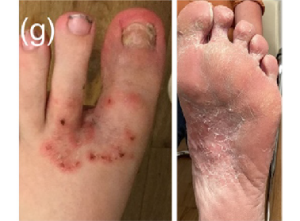
Distinguishing characteristics: Tense bullae or vesicles containing clear fluid, intense pruritus, symmetric distribution, and predilection for flexural areas and limb roots; mucosal involvement is uncommon.
Acrodermatitis continua suppurativa
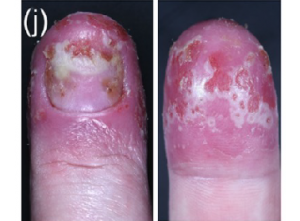
Distinguishing characteristics: Acrodermatitis continua suppurativa (Hallopeau) with similar intraepidermal, spongiotic pustules filled with neutrophilic granulocytes, typically localized and often associated with nail changes. The pustules are accompanied in the superficial and mid-dermis by a perivascular and interstitial lymphocytic infiltrate.
Accurate differentiation of palmoplantar pustulosis from other pustular and eczematous disorders is essential, as overlapping clinical presentations can lead to misdiagnosis. Recognizing the characteristic sterile pustules, associated triggers, and distinguishing histopathological features helps ensure appropriate diagnosis and targeted management.
Reference:
- Mössner R, Fetter T, Sabat R, et al. Palmoplantar pustulosis: Pathogenesis, differential diagnosis, and treatment. J Dtsch Dermatol Ges. 2026;24(4):516–535.
Expert opinion – Dr. Keshava
PPalmoplantar pustulosis is a chronic and often challenging inflammatory skin disorder characterized by recurrent sterile pustules affecting the palms and soles. The condition can be particularly debilitating due to associated pain, discomfort, and its significant impact on patients’ daily activities and quality of life. It is more commonly seen in women and has a well-established association with smoking. Clinically, patients may present with recurrent pustules on an erythematous or hyperkeratotic background, with manifestations ranging from classic pustular lesions to hyperkeratotic and dyshidrosiform variants. Given its varied presentation, careful clinical evaluation is essential to differentiate PPP from conditions such as chronic hand eczema, dyshidrosiform eczema, tinea infections, and acrodermatitis continua suppurativa. Early recognition and appropriate management are key to achieving better disease control and improving patient outcomes.