

The impact of vitamin D receptor gene polymorphisms (FokI, ApaI, TaqI) in correlation with oxidative stress and hormonal and dermatologic manifestations in polycystic ovary syndrome
Dr. Ravi H B
MBBS, DVD, Skin Specialist
Sridevi Skin Care Centre

Polycystic ovary syndrome (PCOS) is a common and complex disorder involving multiple systems. Emerging data suggests a link between genes involved in vitamin D metabolism, specifically vitamin D receptor (VDR), and the metabolic, endocrine, and skin manifestations of PCOS.
Researchers evaluated the association between VDR gene polymorphisms and cutaneous manifestations, to find a correlation between hormonal parameters, oxidative stress and skin manifestations in women with PCOS, and to determine the impact of VDR gene polymorphisms on these parameters.
This case-control study included participants matched by age and body mass index (BMI), comprising 46 women with PCOS and 39 control women. Dermatologic and hormonal assessments were conducted to evaluate acne, hirsutism, seborrhea, androgenetic alopecia, oxidative stress, and androgen hormones. VDR gene polymorphisms ApaI, FokI and TaqI were examined by polymerase chain reaction restriction fragment length polymorphism, and the androgen hormone (total testosterone, dehydroepiandrosterone sulfate), sex hormone binding globulin and malondialdehyde levels were assessed.
The effects of VDR-ApaI, VDR-FokI and VDR-TaqI gene polymorphisms on hormonal, oxidative stress and clinical cutaneous manifestations parameters in cases of women with PCOS and control women were analyzed by codominant, dominant (AC + AA vs. CC for VDR-ApaI, CT+CC vs. TT for VDR-FokI, CT+TT vs. TT for VDR-TaqI), recessive (AA vs. CC+AC for VDR-ApaI, CC vs. CT+TT for VDR-FokI, TT vs. CT+CC for VDR-TaqI) and allelic genetic models:
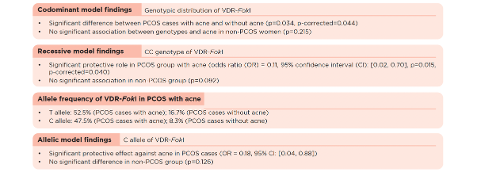
Interaction between PCOS and VDR-FokI polymorphism affects the odds of acne. VDR-TaqI polymorphism (Dominant genotype): Protective effect against oxidative stress (lower MDA levels) compared to the TT genotype.
FokI CC genotype may have a protective role against both acne and seborrhea in women with PCOS, while the VDR-TaqI dominant genotype is associated with diminished oxidative stress in PCOS patients.
Reference: Talida V, Tudor S, Mihaela I, et al. The impact of vitamin D receptor gene polymorphisms (FokI, ApaI, TaqI) in correlation with oxidative stress and hormonal and dermatologic manifestations in polycystic ovary syndrome. Medicina. 2024;60(9):1501.